
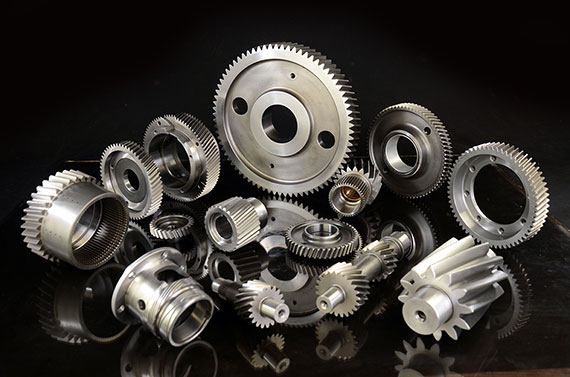
Helical Gears have angled teeth that engage gradually, ensuring smoother and quieter operation than spur gears. Suitable for both parallel and angled shafts, they handle higher loads with greater durability. Commonly used in automotive, industrial, and high-speed applications, helical gears offer enhanced strength with slightly lower efficiency due to sliding friction.
These gears are extensively used in gearboxes, conveyors, elevators, compressors, and automotive transmissions. Their quiet operation and strength make them ideal for high-speed, heavy-duty applications where smooth power transmission and reliability are critical.
Helical gears are one of the most widely used gear types in modern industry. Unlike spur gears, their teeth are cut at an angle to the gear axis, allowing gradual tooth engagement and smoother operation. This unique design reduces noise, increases efficiency, and provides higher load-carrying capacity.
Helical gears are one of the most widely used gear types in modern industry. Unlike spur gears, their teeth are cut at an angle to the gear axis, allowing gradual tooth engagement and smoother operation. This unique design reduces noise, increases efficiency, and provides higher load-carrying capacity.
Helical gears can be classified into two main categories: parallel shaft helical gears and crossed helical gears. Parallel shaft gears transmit motion between parallel shafts, while crossed helical gears work at non-parallel, non-intersecting axes.